
Retail furniture that is easy to maintain is shaped by decisions made before production: how it will be cleaned, which parts can be replaced and how those parts can be reached. The finish matters, but so do the joints, spare parts and instructions given to the store team.
Consider a display table whose top is scratched during restocking. The frame is still sound and the unit still serves its purpose. What happens next depends partly on a decision made months earlier: whether the top can be removed on its own or replacing it means working on the entire unit.
Planning for that intervention from the outset makes it easier to compare solutions on their merits. A quotation states how much the unit costs to make; the design should also explain what will be needed to keep it in use.
Maintenance works best when cleaning, access and spare parts are considered before the furniture goes into production.
Start with the areas most likely to be touched and knocked
A side panel next to a trolley route does not face the same conditions as a high shelf. Nor is a surface used for product testing cleaned in the same way as a decorative panel. Asking for a “durable” material across the entire fit-out leaves too many questions unanswered.
Before signing off the design, spend a working day with the people who restock, serve customers and clean the store. Watch where they place boxes, which corners get brushed in passing and which elements need to be moved. If the store has not opened yet, reproduce those actions with a sample or prototype.
That review can be turned into a short use sheet:
| Furniture area | Situation to anticipate | Decision to resolve |
|---|---|---|
| Display top | Product handling, abrasion and frequent cleaning | A finish suited to the intended use and the option to replace the top |
| Corners and plinths | Contact with trolleys, footwear or cleaning equipment | Geometry, protection and access to the damaged part |
| Drawers and doors | Repeated opening and variable loads | Suitable hardware, adjustment and a replacement reference |
| Graphic holders | Campaign changes | An accessible fixing that does not damage the holder at every change |
| Recesses and joints | Build-up of dust or debris | Practical access for cleaning without unnecessary dismantling |
This sheet does not prescribe materials or thicknesses. Its purpose is to give designers, manufacturers and store operations the same picture of how the furniture will be used. CAAD’s article on Facility Retail and store management looks at this relationship across the whole store; here, we apply it to each piece of furniture.
Test cleaning before approving the finish
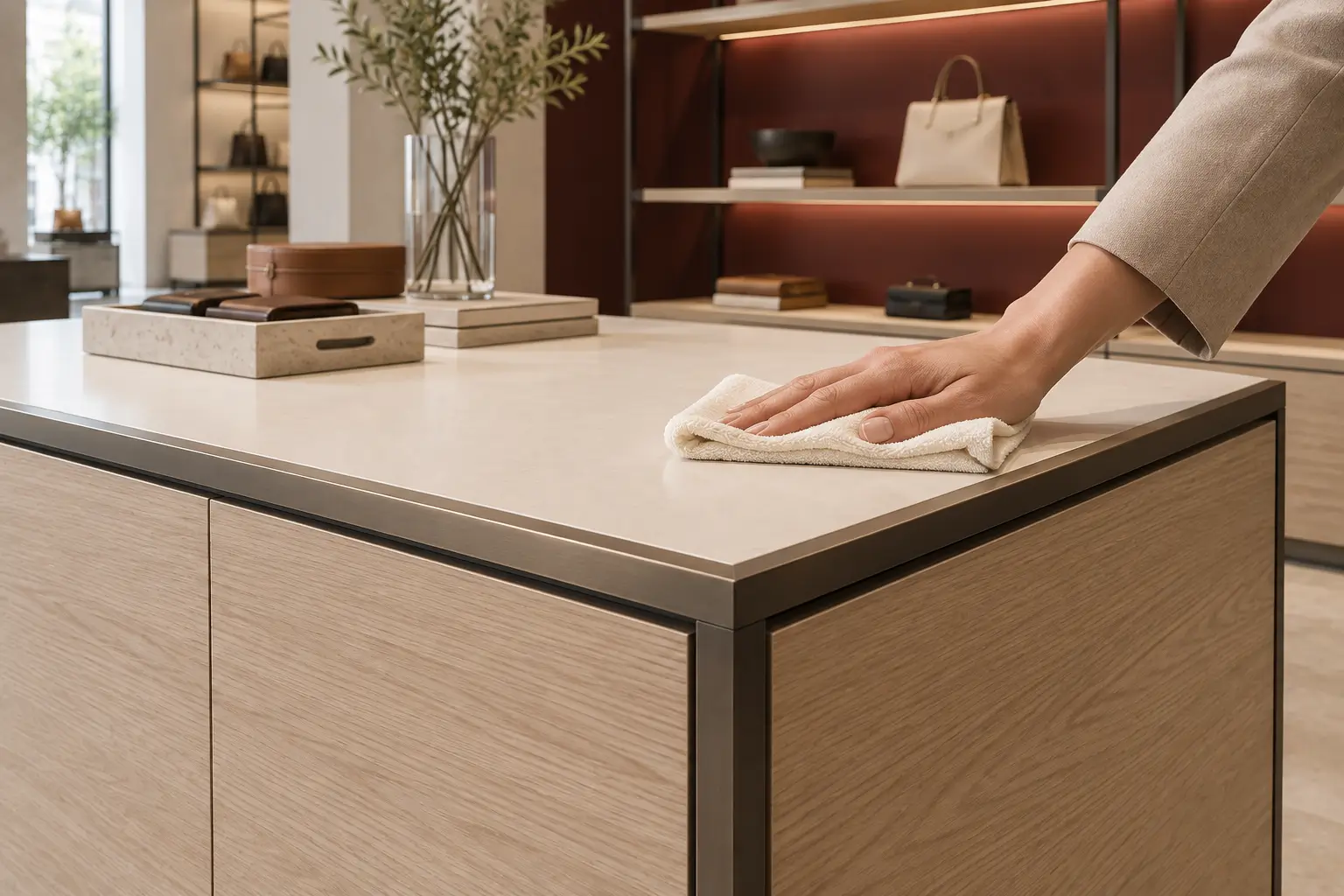
A new sample says little about the day-to-day work a finish will demand. Examine it under the intended lighting and check its maintenance instructions before adding it to the specification. A dark colour, deep texture or highly polished surface may call for different tests; appearance alone does not show how it will respond to use.
Ask the manufacturer for the procedure that applies to the exact product reference. Then test the approved cleaning products and equipment on a sample. Once the surface is dry, check for marks, residue and changes in sheen, and see how easily joints and corners can be reached.
For example, EGGER’s care guide for laminate worktops advises against abrasive ingredients and wax-based cleaners, and recommends removing spills, particularly around joints and cut-outs. These instructions apply to the products covered by that guide; every finish needs its own maintenance information.
The construction detail must support the finish. A narrow gap between two parts may be beyond the reach of cleaning equipment, while a horizontal joint may trap dirt. An assembled sample reveals these problems more clearly than a collection of material swatches.
Separate the frame from parts exposed to wear
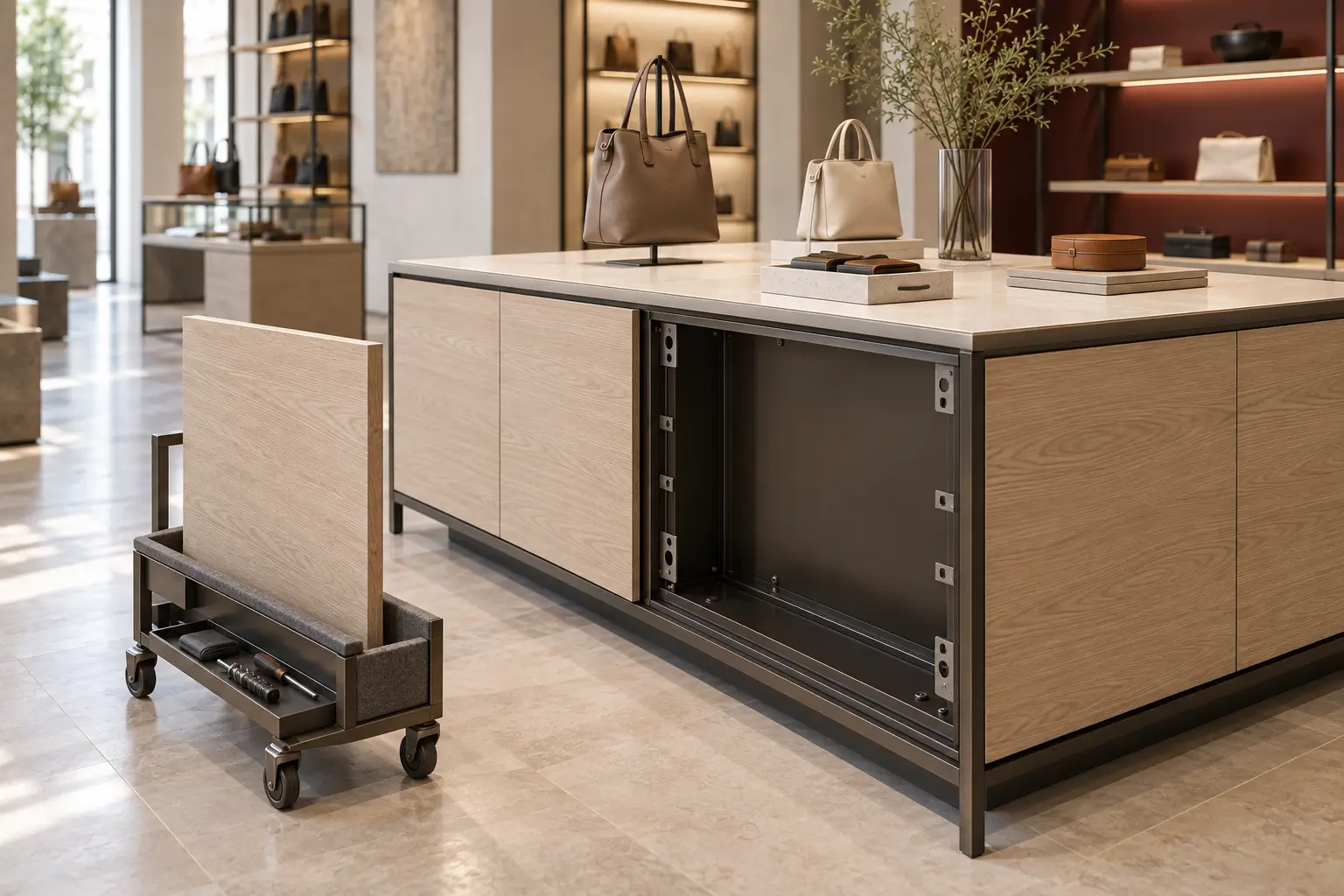
Not every part of a display unit needs replacing at the same time. A top, front panel or plinth may become worn while the frame remains perfectly serviceable. Designing those elements as replaceable components offers an alternative to removing the entire unit.
The Ellen MacArthur Foundation identifies modularity as a way to support repair and upgrading: removing one part makes it possible to work on the damaged component. For retail furniture, the principle is straightforward—identify the parts most likely to wear and establish whether they can be changed without discarding those that still work.
Not every joint needs to be demountable. A fixing must also meet requirements for stability, load, finish and safety. The important point is to decide where dismantling adds value and demonstrate how it will be done.
The part that wears out first should not force a sound piece of furniture out of service.
On an accessories display table, for example, it may be useful to replace the top while leaving the frame in the store. The proposal should show where the fixings are released, how the panel is lifted and whether access remains possible once the unit has been installed. A concealed screw against a wall may work in the workshop and prove impossible to reach in the store.
A spare part needs a reference and a supply route
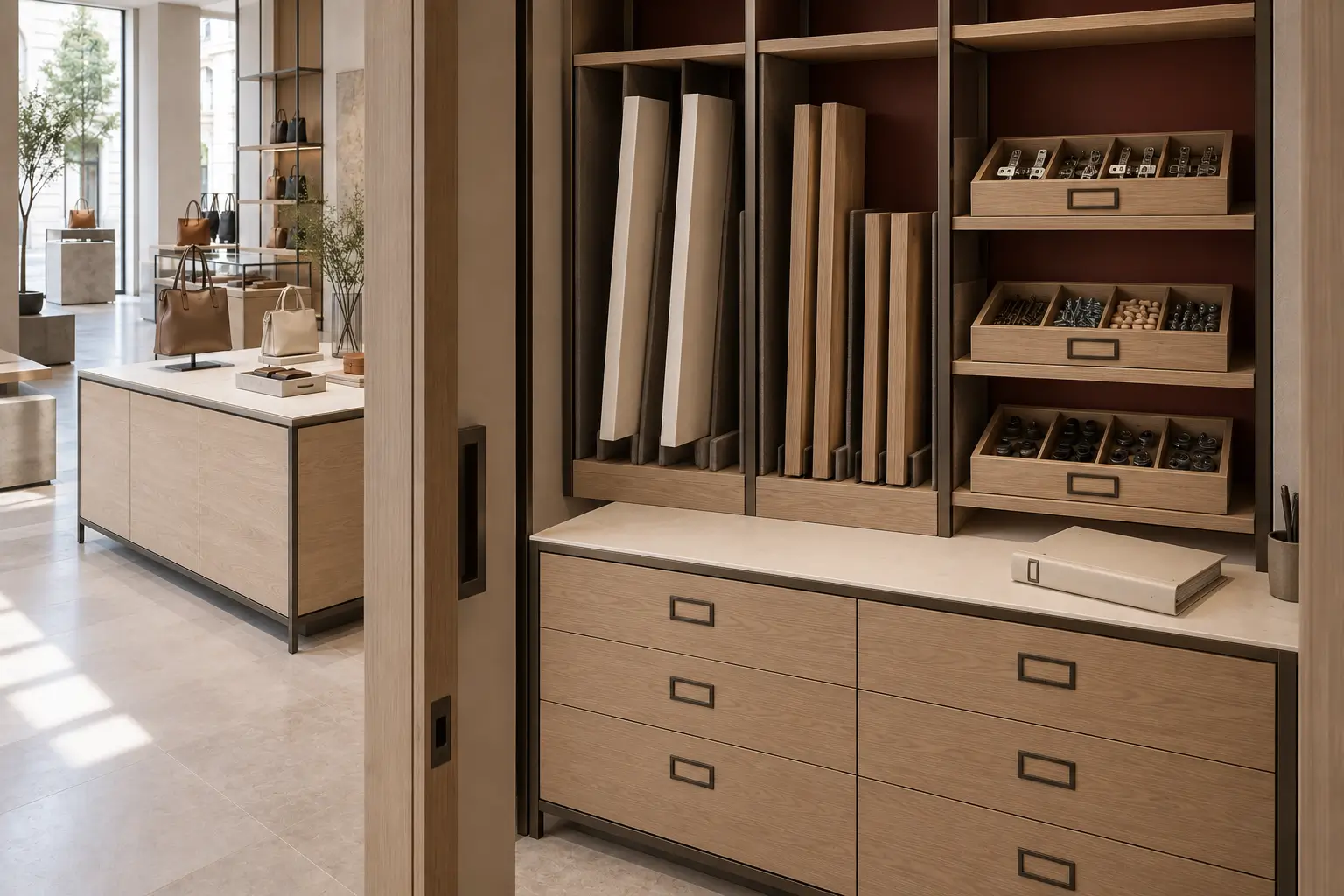
Being able to remove a part does not guarantee that a replacement will be available. When the fit-out is approved, agree with the supplier how each component will be identified, who will supply it and what the alternative will be if it is discontinued.
The documentation should link every reference to its piece of furniture, location, finish and version. A photograph helps people find it; a drawing or data sheet avoids ordering a visually similar part that does not fit. Where several stores share the same furniture, distinguish common components from the variations used at each location.
It is also worth deciding what should be kept in stock. A small item of hardware that fails regularly presents a different need from a bulky panel. Recorded incidents, lead time, available storage and the part’s importance to keeping the unit in use can all guide the decision. Stocking everything without a clear reason simply creates another management problem.
The finish of a spare part needs checking too. An identical reference does not guarantee that a new component will match a surface that has aged in use. Before replacing a highly visible part, compare a sample with the elements that will remain.
Test the maintenance procedure, not just the initial assembly
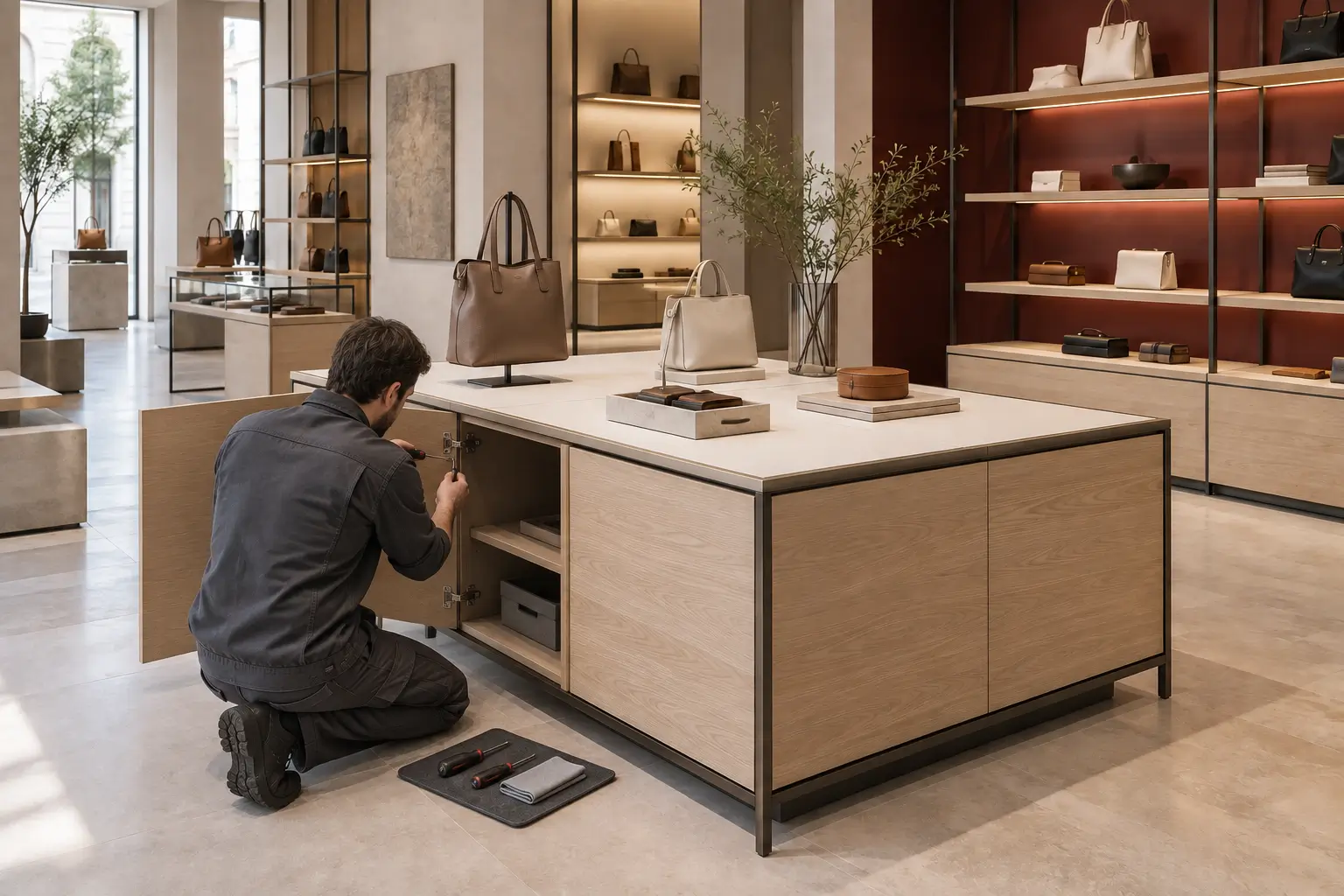
A prototype can be used to check the procedure under conditions close to those in the store. The test may be as specific as removing and reinstalling a front panel, reaching a fitting or changing a graphic holder.
Ask the person who will carry out the work to follow the instructions and note where help is needed. Check which tools they use, which products must be removed from the unit and how much room the task requires. If the furniture needs to be moved, review its anchors and the clearance around nearby elements. Any electrical work should be left to qualified personnel.
The test should end with the furniture ready for use again: components secured, stability confirmed and the finish checked. Taking it apart is only one part of the job.
Video: designing for repair
Access to individual parts and the way the assembly is organised both affect how easily something can be repaired. This lesson from TU Delft’s Engineering Design for a Circular Economy course discusses principles such as improving access and using a modular structure.
Educational video by TU Delft. Watch Design for Repair — Customers on YouTube.
In a store, this approach raises three practical questions: how the component that may fail can be reached, which tools the intervention requires and whether it can be replaced while the rest of the unit remains in service. A prototype provides the opportunity to answer them before the production run begins.
For retail furniture, these principles need to reflect the loads, anchors and intended use of each component. The full TU Delft OpenCourseWare material expands on the approach introduced in the video.
Compare quotations on a like-for-like basis
Two pieces of furniture with a similar appearance may include very different services and documentation. To compare them properly, ask each quotation to state which components can be supplied separately, what instructions come with the unit and how a replacement request will be handled.
The comparison should include transport, access to the premises, labour and the time for which the unit will be out of service. There is no need to turn those variables into a promised saving. Without evidence on the frequency of incidents or the cost of spare parts, any figure will remain an estimate.
A useful question for the approval meeting is: “If this part is damaged, what will we need to put the furniture back into use?” The answer should identify a reference, a procedure and the relevant supply conditions.
A well-resolved proposal explains how the furniture will be returned to use after something goes wrong.
Give the team instructions they can actually use
A maintenance manual does not have to be long to be useful. Each furniture family should come with the information needed to identify it and take the right action:
- References for the complete unit and its replaceable parts, with photographs or drawings showing their location.
- Cleaning instructions for the finishes that were actually installed.
- Tasks the store team may carry out and work reserved for technical specialists.
- The access, removal and reassembly sequence, including tools and final checks.
- The supply contact and agreed conditions for ordering spare parts.
After opening, record what fails and where it happens. If the same plinth is knocked in several stores, review its position, protection and the restocking route before simply placing the same order again.
CAAD brings together design, bespoke manufacturing, installation and logistics through CAAD 360º. Asking these questions at the start of a project helps connect the appearance of the space with the way it will be used every day. To prepare the next brief, begin with three real actions—cleaning, restocking and replacing—and ask the design to explain how each one will be carried out.

Looking for retail furniture designed for day-to-day use?
At CAAD, we design and manufacture bespoke furniture with brand identity, store operations and future maintenance work in mind.
Let’s talk about your next retail space.
Frequently asked questions about retail furniture maintenance
What makes retail furniture easy to maintain?
Surfaces suited to their intended use, areas that are accessible for cleaning, replaceable parts and clear documentation. An identified supplier and agreed replacement conditions are also needed.
Should all retail furniture be demountable?
No. Priority should be given to components that will need access, repair or replacement, provided the solution preserves the stability and safety of the complete unit. The technical design and assembly tests should confirm this.
What should be requested before a run of display units goes into production?
Samples of the specified finishes, cleaning instructions, relevant component drawings and a test of the planned maintenance procedures. Spare-part references and supply conditions should also be agreed before the production run is approved.
Can the maintenance of furniture already installed in stores be improved?
Yes. Start by documenting references, reviewing cleaning procedures and recording incidents. Any change to fixings, panels or access points should be reviewed with the manufacturer or responsible technician before it is carried out.
